
Yard Drainage Solutions for Clay Soil in the DC Area
Why yards in Northern Virginia, DC, and Maryland stay soggy, how to find the cause, and the drainage fixes that work in heavy clay soil.
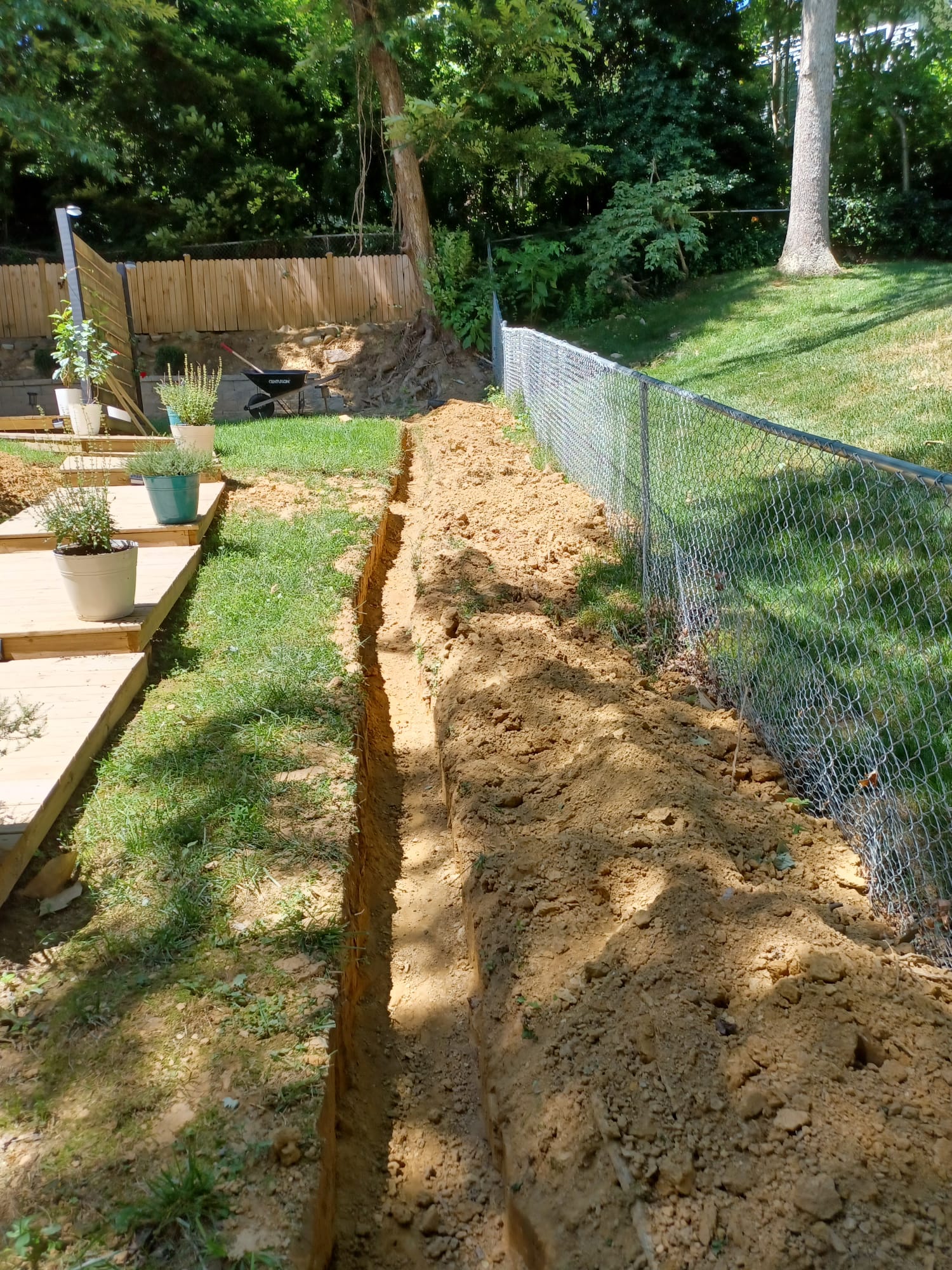
Standing water after every storm, a lawn that squishes for days, a muddy path where the gutters overflow, or worse, water heading for the basement. In Northern Virginia, Washington, DC, and suburban Maryland, the cause is usually the same combination: heavy clay soil and summer downpours.
The good news is that most soggy yards can be fixed. The key is finding where the water comes from before choosing a fix. This guide walks through how to diagnose the problem and which solutions work in clay.
Why DC area yards hold water
- Clay soil. Much of Northern Virginia and Montgomery County sits on heavy Piedmont clay. Its particles are so fine that water moves through it slowly, sometimes only a fraction of an inch per hour.
- New construction. Builders often strip the topsoil, compact the subsoil with heavy equipment, and spread a thin layer of topsoil back on top. Water soaks into that thin layer and stops.
- Summer storms. Thunderstorms can drop an inch or more of rain in an hour. Even good soil cannot absorb water that fast.
- Roofs, driveways, and patios. Every hard surface sends its rain somewhere. A single downspout can dump hundreds of gallons in one spot during a storm.
- Shared slopes. In townhome rows and close neighborhoods, water from several yards often collects in one low spot.
Find the source before you fix it
Watch during a storm. Put on a raincoat and walk the property while it is raining. Where does water enter the yard, where does it flow, and where does it stop? A few phone photos will help anyone you hire.
Trace every downspout. Many soggy areas are simply a downspout or two emptying into the wrong place.
Check the grade at the house. Building codes generally call for the ground to fall about 6 inches over the first 10 feet away from a foundation. Over the years, settled backfill and mulch piles often flatten or reverse that slope.
Do a simple percolation test. Dig a hole about 12 inches deep, fill it with water, and let it drain. The next day, fill it again and measure how fast the level drops. If it falls less than about half an inch per hour, the soil is too tight for water to soak in quickly, and fixes that move water will work better than fixes that rely on it soaking in.
Notice when it is wet. A yard that is soggy only after storms has a surface water problem. A spot that stays wet during dry weeks may have groundwater or a spring, which calls for a different approach.
Drainage fixes, from simplest to most involved
1. Move the downspout water
Extend downspouts at least 5 to 10 feet from the house, or connect them to buried solid pipe that carries water to a pop-up emitter or a lower part of the yard. Keep gutters clear, especially during fall leaf drop. This is often the least expensive fix, and it solves more problems than people expect.
2. Regrade around the house
Rebuild the slope away from the foundation with compacted soil, not mulch or sand. Leave several inches of clearance between the soil and the siding, and keep brick weep holes uncovered.
3. Add a swale
A swale is a shallow, wide, grassy channel that guides surface water to a safe outlet. It looks like a gentle dip in the lawn, it can be mowed, and it is one of the most reliable fixes for water crossing a yard.
4. Install a French drain
A French drain is a trench lined with filter fabric, filled with washed stone, and fitted with perforated pipe. It collects water from soggy ground and carries it away. In clay, a French drain moves water rather than soaking it into the ground, so it must have a downhill outlet. Common mistakes include no real outlet, the wrong filter fabric clogging with fine clay, and a trench without enough fall.
5. Use catch basins and channel drains
A catch basin is a grated box set in a low spot of lawn. A channel drain is a slotted trench drain across a patio edge or the bottom of a driveway. Both connect to solid pipe that carries water away.
6. Consider a dry well carefully
A dry well is an underground chamber that holds water while it soaks into the soil. It works well in sandy ground. In tight clay, it can fill up and stay full, which is why a percolation test should come first.
7. Plant a rain garden
A rain garden is a shallow planted basin that catches runoff from a roof or driveway and lets it soak in over a day or two. Place it at least 10 feet from the foundation, away from septic fields and buried utilities, and fill it with plants that handle both wet and dry spells. Our guide to the best native plants for Northern Virginia, DC, and Maryland lists rain garden favorites such as buttonbush, swamp milkweed, and Virginia sweetspire.
8. Improve the soil under the lawn
For a lawn that stays soft and squishy, yearly core aeration followed by a thin layer of compost slowly improves how water soaks in. See when to aerate and overseed in the DC area.
9. Choose permeable paving
Permeable pavers let rain pass through the joints into a deep stone base instead of running off. They are worth considering for new patios and driveways in problem areas. Our paver patio cost guide covers how they compare.
Match the problem to the fix
| What you see | Usually fixed by |
|---|---|
| Puddles by the downspouts | Downspout extensions or buried pipe |
| Water flowing toward the house | Regrading, a swale, or both |
| A soggy strip along a slope or fence line | A swale or a French drain |
| A low spot in the lawn | Regrading, a catch basin, or a rain garden |
| Water pooling on a patio or driveway | A channel drain or releveling |
| Wet ground even in dry weeks | Investigating groundwater, often with a French drain |
Rules, neighbors, and rebates
Do not send the problem next door. Directing water onto a neighbor's property or across a public sidewalk, where it can freeze, invites disputes and code issues.
Call before you dig. Drainage trenches cross buried lines. In Virginia, Maryland, and DC, Miss Utility marks them for free when you call 811.
Bigger grading may need approval. Large regrading, work near streams, floodplains, or Chesapeake Bay Resource Protection Areas in Virginia, and work in public space can require a permit. Rules differ by county and city.
Check for rebates. Local programs such as RiverSmart Homes in DC, RainScapes in Montgomery County, and StormwaterWise Landscapes in Arlington have offered incentives for rain gardens, native plantings, and permeable paving. Availability changes, so check the current rules for your address before you build.
When to call a professional
Some drainage work is a weekend project. Call a pro when:
- Water is reaching the foundation or the basement. A waterproofing contractor may also be needed for the interior.
- A slope is eroding, or a retaining wall is leaning.
- The fix needs regrading near the house or across a large area.
- Water crosses a property line.
- You have tried a simple fix and the problem came back.
We plan drainage into every patio, walkway, and retaining wall we build, and every landscape design starts with where the water goes. We work across Fairfax, Arlington, Springfield, Lorton, Rockville, Silver Spring, and Washington, DC. Request a free on-site estimate and we will walk the property with you, ideally after a good rain.
Frequently asked questions
Will adding sand fix my clay soil?
Usually not. Mixing a modest amount of sand into clay can make it denser and harder. Organic matter such as compost, worked in over time, does far more to open up clay.
Can drainage work be done in winter?
Yes, whenever the ground is not frozen. Winter rains also make drainage problems easy to see, which helps with planning.
What is the difference between a French drain and a swale?
A swale moves water across the surface in a shallow grassy dip. A French drain collects water below the surface and carries it through a pipe. Swales are simpler and cheaper when there is room for one. French drains fit where a dip in the lawn would not work, or where water is soaking in from the side.
How do I know if the water is coming from my neighbor's yard?
Watch during a storm and look at where the water enters your property. If a neighbor's downspout or grading is the source, a swale or French drain along the shared line can intercept it, and a friendly conversation with your neighbor is often the best first step.